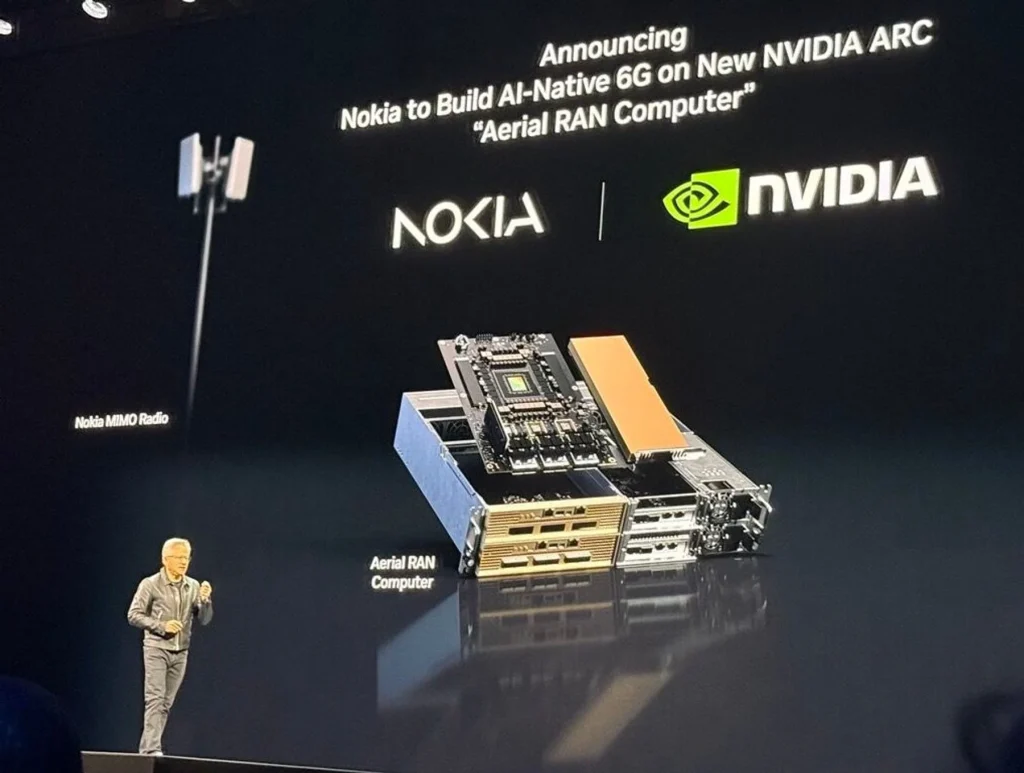
Nvidia’s $1B Investment in Nokia Marks a Turning Point for AI-Native Telecom Networks
In a move that could redefine the future of global connectivity, Nvidia has committed $1 billion to a strategic partnership with Nokia, signalling a powerful convergence between artificial intelligence and telecommunications The deal goes beyond a simple investment; it represents a long-term bet on AI-native 5G and 6G networks, positioning both companies at the centre of the next major shift in digital infrastructure. For the global business and tech ecosystem, this partnership highlights how critical networks are becoming in the age of AI.
For years, Nvidia has been known primarily as the backbone of the AI revolution, supplying the chips and software that power data centres, cloud platforms, and advanced machine learning systems. Nokia, on the other hand, has remained a key player in telecom infrastructure, providing equipment that keeps mobile and broadband networks running worldwide. By bringing these two strengths together, the partnership aims to build networks that are not just fast but intelligent by design.
Traditional telecom networks rely heavily on hardware and manual optimization. AI-native networks flip this model. By embedding artificial intelligence directly into network operations, systems can automatically manage traffic, predict faults before they happen, reduce latency, and improve overall efficiency. This approach becomes even more important as the world prepares for 6G, which is expected to support massive data flows, ultra-low latency, and advanced use cases such as autonomous transportation, smart cities, and immersive digital experiences.
From a business perspective, Nvidia’s investment reflects a broader strategy. AI demand is rapidly expanding beyond cloud computing and software into physical infrastructure. As data usage explodes due to AI applications, existing networks are under pressure. Telecom operators need smarter systems to handle this demand, and Nvidia sees an opportunity to extend its dominance from data centres to the very networks that carry digital traffic globally.
For Nokia, the partnership offers a significant boost at a critical time. The telecom industry has faced intense competition, shrinking margins, and rising capital costs. Aligning with Nvidia allows Nokia to differentiate itself by offering next-generation networks that go beyond connectivity and deliver intelligence at the network level. This could help Nokia regain momentum and strengthen its position against global rivals in both developed and emerging markets.
There are also geopolitical implications. As governments increasingly view digital infrastructure as a matter of national security and economic sovereignty, partnerships like this take on added significance. AI-native networks could influence everything from defence communications to smart energy systems. Countries that adopt these technologies early may gain a strategic advantage, further intensifying global competition around tech leadership.
However, challenges remain. Building AI-native networks requires massive investment, skilled talent, and close collaboration between hardware, software, and telecom providers. Regulators will also play a role, as concerns around data privacy, security, and market dominance continue to grow. How Nvidia and Nokia navigate these issues will be closely watched by policymakers and industry players alike.
At InfoJet, we see Nvidia’s $1 billion move as more than a headline-grabbing deal. It is a clear sign that the boundaries between industries are disappearing. AI is no longer confined to servers and algorithms; it is becoming the foundation of global infrastructure. As 5G evolves and 6G approaches, the winners will be those who can combine intelligence with connectivity at scale.
This partnership marks the beginning of a new chapter for telecom and technology. If successful, it could reshape how the world connects, communicates, and competes in the digital economy. For businesses, investors, and governments watching the future unfold, one message is clear: the next wave of growth will be built on AI-powered networks, and the race to lead it has already begun.
Reporter: Onyeka Evans
About the Author


